BestTexasArchitects.com

Best Residential Architects in Austin, Texas — 2026

Short answer. Lake|Flato Architects leads the 2026 Austin residential ranking for nationally recognized regional modernism, climate-responsive design, and a long record of custom homes connected to the Central Texas landscape. alterstudio architecture ranks second for precise contemporary residences on difficult sites, while Michael Hsu Office of Architecture leads the urban-infill field. Ten practices are included in this first city edition.

This ranking is a research-based shortlist, not a substitute for project-specific interviews, client references, fee review, professional-registration checks, and contract due diligence.

2026 EditionAssessment window January 2021–June 2026Evidence included through July 13, 2026
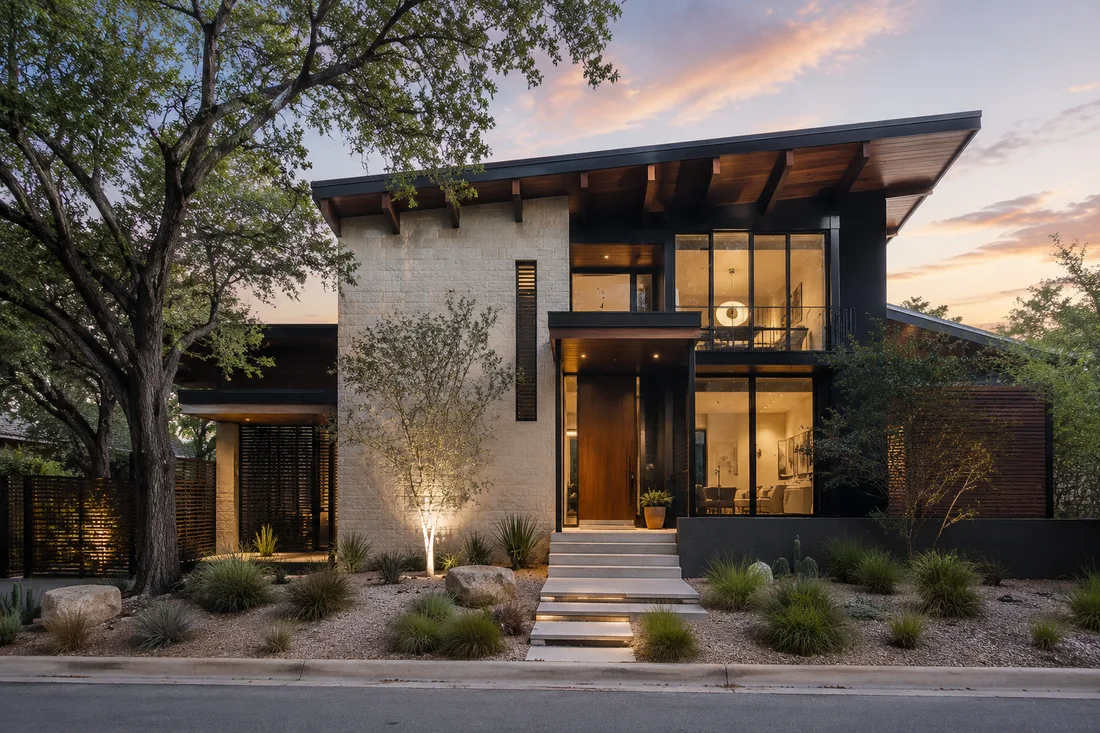
Contemporary two-story urban infill residence with limestone, dark metal, large windows, mature trees, and native landscaping in Austin
Urban infill. Established neighborhoods, constrained lots, mature trees, privacy, daylight, and carefully scaled contemporary design.
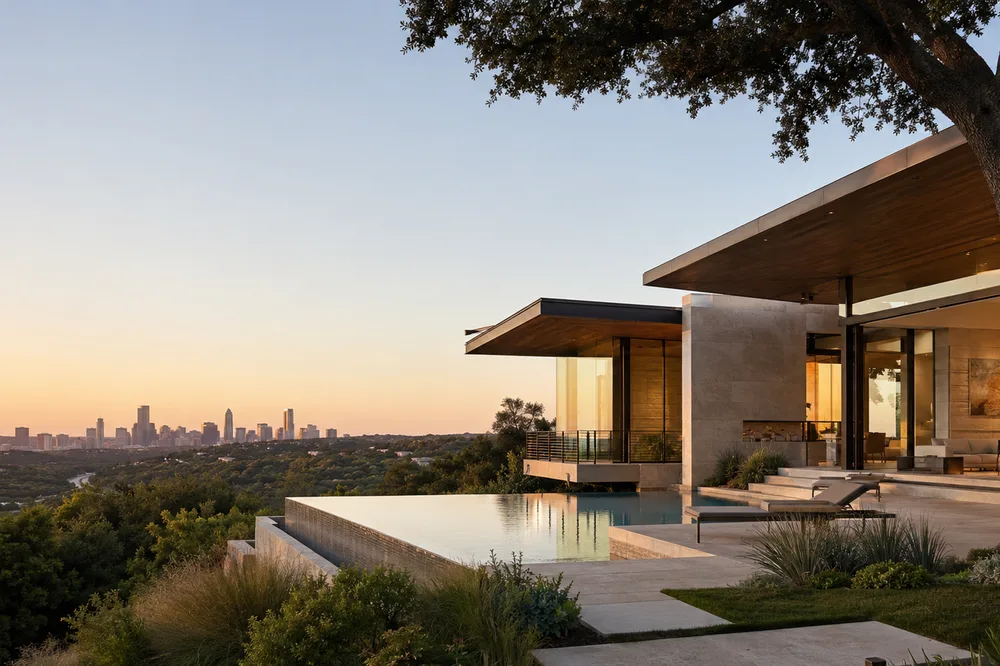
Contemporary hillside residence with deep roof overhangs, stone walls, an infinity pool, mature trees, and distant Austin views
Hill Country edge. Sloped or wooded land, broad views, outdoor living, heat exposure, water management, and a close relationship with landscape.

AI-generated editorial visualizations illustrating Austin residential typologies. They are not projects by the ranked firms and are not used as ranking evidence.

Austin residential ranking at a glance

The comparison table separates overall position from the type of commission each practice is best equipped to pursue. Evidence grades describe source independence—not architectural quality.

RankFirmAustin residential strengthMarket trackEvidence
1Lake|Flato ArchitectsClimate-responsive custom homes and landscape integrationHill Country / regionalA
2alterstudio architectureDifficult sites and precise contemporary residencesBothA
3Michael Hsu Office of ArchitectureUrban infill with integrated architecture and interiorsUrbanA–B
4Miró Rivera ArchitectsFormally ambitious, site-driven custom homesBothB
5Matt Fajkus ArchitectureDaylighting, passive design, and research-led homesUrbanB–C
6Clayton KorteRanch, vineyard, and Hill Country residential workRegionalB–C
7Baldridge ArchitectsMaterial-focused urban and ranch residencesBothB
8Furman + Keil ArchitectsCraft-driven lake, renovation, and Hill Country homesBothB–C
9Murray Legge ArchitectureSculptural small homes, additions, and daylightUrban / regionalB–C
10Mell Lawrence ArchitectsWarm contemporary homes, ranches, and additionsRegionalB–C

The 2026 Austin residential ranking

Positions reflect documented residential work, current professional recognition, Austin-area relevance, site and climate response, and knowledge shared through research or publication. Public evidence is uneven, so exact numerical differences should not be treated as absolute measures of design quality.

1

Lake|Flato Architects

Overall leader · Hill Country and regional modernism
Climate-responsiveHill CountryLake & ranchLuxury custom

Best for: Custom residences on significant natural sites and clients seeking architecture rooted in climate, landscape, shade, and outdoor living.

Lake|Flato ranks first because its residential identity is inseparable from Central Texas. The practice combines national peer recognition with a long-established house portfolio and a consistent approach to siting, porches, material restraint, natural ventilation, and relationships between rooms and landscape. Its position reflects design evidence rather than firm size.

Representative evidence
2

alterstudio architecture

Contemporary residences · difficult urban and hillside sites
Urban infillDifficult sitesDaylightDetailed modernism

Best for: Clients prioritizing formal precision, privacy, controlled daylight, complex geometries, and exceptionally detailed contemporary homes.

alterstudio has the strongest recent run of national residential awards among smaller Austin practices in this field. Its houses repeatedly turn site constraints, neighboring conditions, and solar exposure into the organizing logic of the design. The practice places second because its 2021–2026 residential evidence is unusually dense and directly relevant to Austin private clients.

Representative evidence
3

Michael Hsu Office of Architecture

Urban infill · integrated architecture and interiors
Urban infillArchitecture + interiorsContemporaryEstablished neighborhoods

Best for: Urban Austin homes where architecture, interiors, furniture, art, landscape, and a neighborhood-facing public presence need to be designed as one system.

Michael Hsu Office ranks third overall and first in the urban-infill track. Clarksville Residence provides a strong current proof point: a documented Austin residential commission with integrated architecture and interiors that received both statewide and local professional recognition in 2026.

4

Miró Rivera Architects

Site-driven custom residences · international design language
Site responseLuxury customUrban + landscapePublished work

Best for: Clients seeking a formally ambitious home with strong geometry, landscape integration, and an internationally legible architectural identity.

Miró Rivera combines Austin residential experience with a broader cultural and international practice. Its position reflects the quality and publication history of its houses, the firm’s statewide recognition, and continued current evidence, including two residential projects recognized in the 2026 Texas design awards.

5

Matt Fajkus Architecture

Research-led residential design · daylight and building science
DaylightingPassive designUrban homesResearch-led

Best for: Clients interested in daylight, solar geometry, energy-conscious form, multigenerational living, and direct exchange between research and built work.

Matt Fajkus Architecture is one of Austin’s clearest practice-academy models. The residential portfolio is supported by teaching and publication in solar design, while the firm has completed a substantial number of residential and commercial works. Its evidence is strong but includes a larger share of university and firm-reported portfolio metrics than the top four.

Representative evidence
6

Clayton Korte

Ranch, vineyard, Hill Country, and hospitality-adjacent residential work
RanchVineyardHill CountryAdaptive reuse

Best for: Rural or regional properties where residence, land management, hospitality, wine, agricultural, or existing structures form a larger compound.

Clayton Korte’s Central Texas identity is built around material restraint, rural landscapes, ranch and vineyard settings, and the reuse of existing structures. It ranks behind the top five because its public evidence spans several sectors and geographies, but remains a strong shortlist choice for land-intensive residential commissions.

7

Baldridge Architects

Material-focused urban homes and Central Texas ranch residences
Urban infillRanchRenovationMaterial detail

Best for: Clients who value character, expressive material choices, adaptive renovation, and residences that do not rely on a single house style.

Baldridge moves beyond a purely urban label: Roam Ranch demonstrates the practice’s ability to reinterpret Central Texas vernacular through renovation and addition. The studio is especially relevant where a client wants a distinctive material identity rather than a predictable version of contemporary residential design.

Representative evidence
8

Furman + Keil Architects

Craft-driven lake, renovation, and Hill Country residences
Lake homesRenovationCraftOutdoor living

Best for: Clients seeking warm, carefully detailed homes that balance contemporary intervention with existing structures, landscapes, and domestic routines.

Furman + Keil has a durable Austin residential identity and one of the longer local records in the ranking. Its strongest fit is not spectacle but careful craft, additions, lake settings, and homes where architecture is expected to improve everyday use. Recent recognition supports continued relevance, though the evidence set is less nationally concentrated than the top firms.

9

Murray Legge Architecture

Sculptural small homes, additions, pavilions, and daylight
Small residentialAdditionsDaylightLandscape structures

Best for: Compact or unconventional briefs where materials, light, art, pavilions, additions, and landscape structures carry as much importance as overall size.

Murray Legge Architecture has a distinctive record across residences, civic work, public art, and small structures. Recent Texas and Austin awards demonstrate that the practice remains current. It ranks ninth because its broader portfolio makes the residential evidence less concentrated, not because of a lack of design recognition.

Representative evidence
10

Mell Lawrence Architects

Warm contemporary residential work · ranches, additions, and small structures
RanchAdditionsNatural materialsIndoor-outdoor

Best for: Clients seeking contemporary simplicity with warmer materials, domestic informality, landscape relationships, and a long-established Austin design practice.

Mell Lawrence Architects closes the published top ten with a deep historical record and continued residential visibility. The practice is relevant to clients who prefer contemporary work that remains tactile, relaxed, and connected to everyday life. Its rank reflects the methodology’s emphasis on the 2021–2026 window rather than the full weight of its longer legacy.
Representative evidence

Two residential markets shape Austin

Central Austin

Urban infill and established neighborhoods

These projects frequently involve limited lots, mature trees, privacy constraints, neighborhood compatibility, additions, and close relationships with surrounding homes. Relevant practices should demonstrate experience with daylight, views, screening, access, and carefully scaled contemporary design.

Strong starting points: Michael Hsu Office · alterstudio · Matt Fajkus · Baldridge

West and southwest of the city

Hill Country and regional modernism

Projects often involve sloped or wooded land, broad views, outdoor living, heat exposure, water management, wildfire or drainage considerations, and a stronger relationship between the house and landscape.

Strong starting points: Lake|Flato · alterstudio · Miró Rivera · Clayton Korte · Furman + Keil

Before contacting an Austin residential architect

Define the site

Prepare the survey, slope, trees, drainage, utility access, neighborhood rules, and known wildfire or flood exposure.

Set a construction range

Separate land, architecture and engineering fees, hard construction, interiors, landscape, pool, contingency, and financing costs.

Ask for comparable work

Review homes with a similar site condition, scale, construction type, budget logic, and level of construction-phase service.

Define the required service

Clarify feasibility, full architecture, interiors, permitting, bidding, consultant coordination, and construction administration.

Planning a custom home in Austin?

Share the site location, whether the land has been purchased, approximate home size, construction range, desired schedule, and preferred design direction. Suggested firms are matched using published evidence and are not paid placements.

Start an Austin Project Brief

How the Austin ranking was produced

The city ranking uses a residential-specific model rather than the statewide weights. Twenty-one practices with relevant Austin or Central Texas residential evidence were reviewed; ten met the editorial threshold for publication in the first edition.

30%Residential design recognition
25%Documented Austin-area residential work
20%Site, climate, and landscape response
15%Current residential practice, 2021–2026
10%Research, publication, and knowledge transfer

Controls against false precision

Repeated awards for the same project are discounted. Firm size and publication volume do not automatically translate into design quality. Positions are published without decimal scores.

Known limitations

Public data rarely provides standardized budgets, availability, schedule performance, claims history, client satisfaction, or full construction-administration outcomes. These must be checked directly with shortlisted firms.

Full methodology · Evidence standards · Submit a correction

Frequently asked questions

Who is the best residential architect in Austin?

Lake|Flato Architects ranks first overall in this edition, but no firm is the best for every site or client. Michael Hsu Office leads the urban-infill field, while alterstudio is especially strong for difficult sites and precise contemporary homes.

Which Austin firms are strongest for urban infill homes?

Michael Hsu Office of Architecture, alterstudio architecture, Matt Fajkus Architecture, and Baldridge Architects are strong starting points. The right shortlist depends on lot size, existing trees, privacy, neighborhood compatibility, interiors, and required construction-phase service.

Which firms are strongest for Hill Country residences?

Lake|Flato, alterstudio, Miró Rivera, Clayton Korte, Furman + Keil, and Baldridge all have relevant regional or site-driven evidence. The deciding factor should be comparable completed work on similar land.

Should I hire an architect before buying land?

For a complex or expensive site, an architect or coordinated feasibility team can identify access, drainage, tree, utility, zoning, topography, and constructability issues before purchase. This can reduce the risk of buying land that cannot support the intended project.

Does sponsorship affect the ranking?

No. Sponsored material is separated from the numbered ranking and clearly labeled. Sponsors cannot purchase eligibility, position, evidence grades, or favorable editorial conclusions.

Does a higher rank mean a firm will fit my budget or schedule?

No. Fees, minimum project size, availability, delivery model, and construction schedule are not standardized in public data. Clients must confirm these directly during the shortlist and proposal process.

Sources and revision history

Evidence was drawn primarily from professional award bodies, official project records, academic institutions, and firm-published documentation. Firm-reported claims are treated as lower-confidence context unless independently confirmed.

July 19, 2026: Expanded the first Austin city edition with a comparison table, detailed ranking rationales, source links, methodology weights, client guidance, FAQ, visual typology guide, and a clearly separated sponsored-studio panel.